
Your phone suggests responses even before you finish typing. Your watch detects an abnormal heart rate and alerts your doctor. A robot on a construction site spots a crack in a concrete slab without human intervention. These three situations rely on artificial intelligence that no longer runs on a distant server, but directly on the device you hold or that works beside you.
The high-tech trends of 2026 are structured around this shift, where data processing gets closer to the field, sensors, and users.
Embedded AI on construction sites: robotics moves out of warehouses
When we talk about robotics, the image that often comes to mind is an articulated arm in a car factory. The reality of 2026 is rougher. Robots equipped with embedded artificial intelligence are now operating on construction sites, outdoors, in unstructured environments where nothing resembles an assembly line.
The ROBOCONS project illustrates this evolution. It structures an open innovation approach to develop AI solutions dedicated to construction robotics, with concrete use cases: automated handling of heavy materials, inspection of structures, and safety monitoring on site. AI does not just follow a fixed program. It adapts its decisions in real-time based on the terrain, the weather, and the presence of unexpected obstacles.
If you follow high-tech news on Geek Network, you have probably noticed that these topics have been gaining momentum for several months. The difference with traditional industrial robots comes down to one word: decision-making autonomy in unpredictable environments.
Lakehouse architecture: how companies merge their data
Have you ever noticed that some applications offer you very fine recommendations almost instantly? Behind this fluidity, there is often an invisible but profound change in how companies store and utilize their data.
Historically, two systems coexisted. The data lake hosted masses of raw data (texts, images, logs). The data warehouse organized structured data for business analysis. Maintaining both in parallel was costly and slowed down projects.
The lakehouse architecture merges these two approaches into a single platform. According to Innowise’s analysis of big data trends for 2026, this model is now presented as the reference standard for modern data platforms. The concrete result: a company can analyze its raw data and structured data in the same place, without duplication or transfer delays.
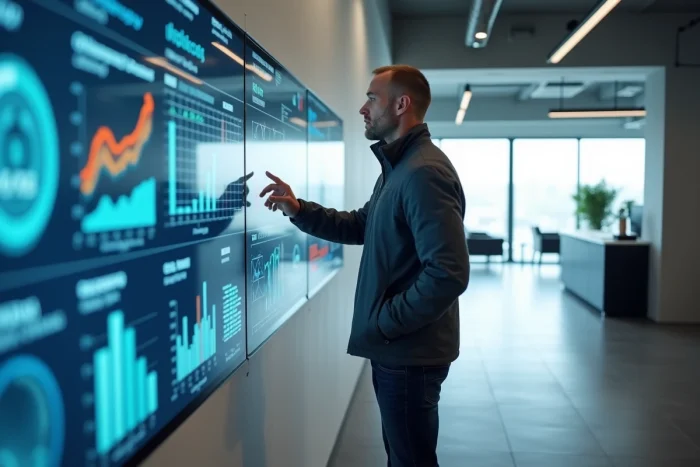
For technical teams, this means fewer data pipelines to maintain. For the end user, this translates into more responsive digital services and more relevant recommendations.
AI-boosted network cybersecurity: what the NDR changes
Cybersecurity is one of the high-tech topics that everyone mentions, but few detail technically. In 2026, a technological brick becomes essential in large organizations: Network Detection and Response, or NDR.
The principle is simple to understand. Imagine a guard who does not just check badges at the entrance of a building, but continuously observes all movements inside, detects abnormal behavior (someone wandering in a restricted hallway at 3 AM), and triggers an alert. The NDR does the same thing on a computer network.
What changes in 2026 is the layer of artificial intelligence integrated into these solutions. AI continuously analyzes network traffic and spots anomalies invisible to a human analyst alone. Darktrace, for example, has been identified as a leader in the Gartner Magic Quadrant 2026 for NDR, for the second consecutive year. This type of recognition accelerates the adoption of these tools by companies that until now relied on a traditional firewall.
Threats evolve too quickly for static rules. The NDR provides a dynamic detection capability that traditional approaches can no longer guarantee alone.
Connected health and smartphones: a convergence that is accelerating
Connected health devices are no longer gadgets reserved for athletes. Watches and bracelets now integrate sensors capable of measuring parameters once reserved for the doctor’s office. The underlying trend in 2026 has a technical name: local processing of health data.
- Embedded sensors in smartwatches analyze heart rate, oxygen saturation, and sleep quality directly on the wrist, without sending each data point to the cloud.
- Smartphone manufacturers like Samsung are integrating health tracking functions at the operating system level, allowing third-party applications to access richer data with user consent.
- Augmented reality is beginning to find concrete medical applications, particularly for motor rehabilitation guided by exercises displayed in overlay in the patient’s field of vision.

This convergence between health and digital raises questions about privacy. Health data processed locally on the device remains better protected than data sent to remote servers, but the regulatory framework is still struggling to keep pace with innovations.
Cloud and digital sovereignty: a challenge for French companies
The massive investment in data centers in France illustrates a fundamental movement. The computing capacity needs related to artificial intelligence are pushing public and private actors to multiply infrastructure projects on national territory.
For French companies, the question is no longer whether they will migrate to the cloud, but which cloud to choose to maintain control over their data. The location of servers on national territory is becoming a selection criterion, not only for performance reasons but also to comply with European regulatory requirements on data protection.
The high-tech news of 2026 is not limited to new smartphones or gadgets showcased at trade shows. The most structuring transformations are taking place in the invisible layers: data architectures, network cybersecurity, field robotics. It is these technical bricks that determine the reliability and speed of the digital services that everyone uses daily.