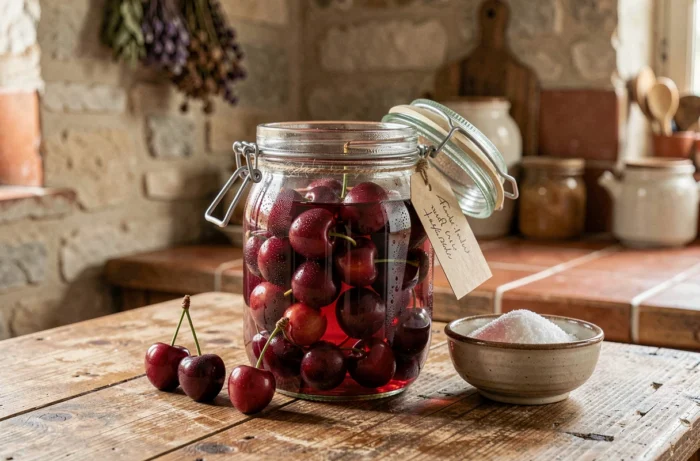
90° alcohol used to make homemade fruit liqueurs is undenatured ethanol, meaning it contains none of the chemical additives that make household alcohol unfit for consumption. Its high alcohol content gives it an ability to extract aromas and preserve fruit that conventional 40° spirits cannot replicate in quite the same way.
Undenatured ethanol: the unseen key to successful fruit liqueurs
Alcohol content alone tells you nothing about what a product contains. A 90° bottle sold in the household-cleaning aisle and a 90° bottle sold in the food aisle may display the same figure, but their compositions are radically different.
Household alcohol contains denaturants (Bitrex, methyl ethyl ketone or other bittering agents) added to prevent ingestion and allow the manufacturer to avoid excise duties on beverages. Food-grade alcohol for fruit, on the other hand, is pure ethanol and is subject to higher taxes because it remains fit for consumption.
Before preparing a jar of cherries or mirabelle plums, there’s one simple check to make: the label must explicitly state that the product is food-grade or intended “for fruit.” If this wording is missing, the product has no place in a recipe. Anyone looking to buy 90° alcohol for fruit at Leclerc will find this type of bottle in the grocery aisle, separate from the household-cleaning section.
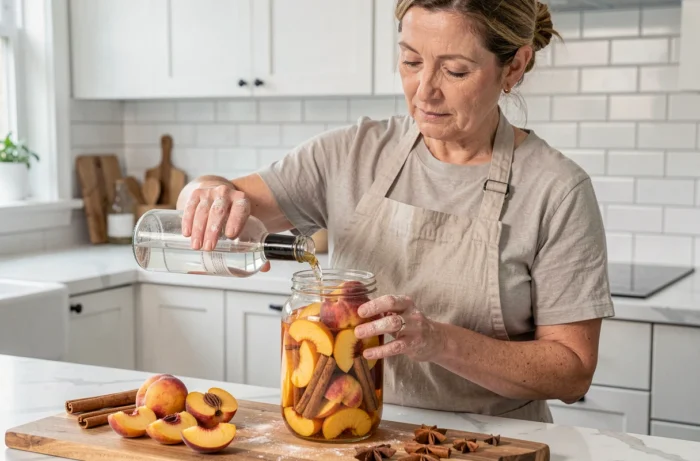
Macerating at 90° and extracting aromas: what the alcohol content actually changes
Ethanol is a solvent. The higher its concentration, the faster it penetrates the fruit’s flesh and extracts aromatic compounds, pigments and natural sugars. At 90°, maceration starts working within the first few hours.
40° alcohol (such as vodka or commercially produced eau-de-vie) also extracts aromas, but more slowly and less completely. The difference is most noticeable with thick-skinned or firm-fleshed fruit such as quinces, pears and green walnuts, where a high alcohol content speeds up extraction without cooking or crushing the fruit.
Preservation and water content
Fruit contains a large proportion of water. As it macerates in 90° alcohol, the water in the fruit gradually dilutes the ethanol in the jar. After a few weeks, the mixture’s final alcohol content naturally drops to around 45–55°.
This gradual dilution is an advantage: it stabilizes the mixture at a level high enough to prevent microorganisms from growing, while making the liqueur drinkable without adding a large amount of water. Starting with a high alcohol content compensates for the dilution caused by the fruit itself.
Alcohol content and fruit type: choosing the right base for your recipe
Not all fruit reacts in the same way to high-strength maceration. The starting alcohol content depends on the fruit’s water content, how delicate its flesh is and the result you’re looking for.
- Fleshy, juicy fruit (cherries, strawberries, raspberries) releases a lot of water: 90° alcohol helps maintain a final alcohol content high enough for preservation and intense flavor.
- Firm-fleshed or dry fruit (quinces, citrus peels, green walnuts) needs a longer maceration time. 90° alcohol speeds up penetration and can cut the process by several weeks.
- Herbs and spices (vanilla, anise, gentian) used in artisanal liqueurs also benefit from a high alcohol content, which quickly extracts their essential oils.
- For recipes where the fruit is eaten whole (fruit preserved in eau-de-vie and served for dessert), alcohol between 40° and 55° may be enough, as it leaves the fruit with a softer texture.
Macerating at 90° is therefore not always the best option. It is particularly well suited to homemade liqueurs that are filtered, where the fruit acts as a flavoring agent and is not intended to be eaten as is.
Food-grade 90° alcohol: why it costs more than spirits
A liter of 90° alcohol for fruit costs noticeably more than a liter of vodka or white rum. This difference is not due to the intrinsic quality of the ethanol, but to taxation.
In France, excise duties on undenatured ethyl alcohol are calculated according to the volume of pure alcohol in the product. A liter at 90° contains almost twice as much pure alcohol as a liter at 45°, and the tax reflects this proportion. Manufacturers pass this cost on in the retail price.
Frequent confusion with household alcohol—which is much cheaper because denaturing exempts it from these duties—creates the impression that food-grade alcohol is excessively expensive. In reality, when measured against the volume of usable pure alcohol, the difference compared with a basic spirit is modest.
Home maceration and distillation: two legally distinct activities
Making fruit liqueur by buying commercial ethanol and pouring it over fruit in a jar is maceration. In France, this is permitted for personal use.
Distilling fruit to produce eau-de-vie, however, falls under a different regulatory framework. The status of a bouilleur de cru, which allowed certain individuals to distill their own harvest under specific conditions, has been subject to restrictions in recent decades. Confusing maceration with distillation can lead to legal as well as technical mistakes.
A jar of cherries in alcohol has nothing to do with a still. The distinction may seem obvious, but it sometimes gets lost in conversations where “making your own fruit alcohol” is used to mean either practice.
For successful maceration, the starting point is always the same: food-grade ethanol at the right strength, sound ripe fruit, sugar adjusted to taste, and a clean jar stored away from light. The rest is a matter of patience: a few weeks for small berries and several months for quinces or walnuts.