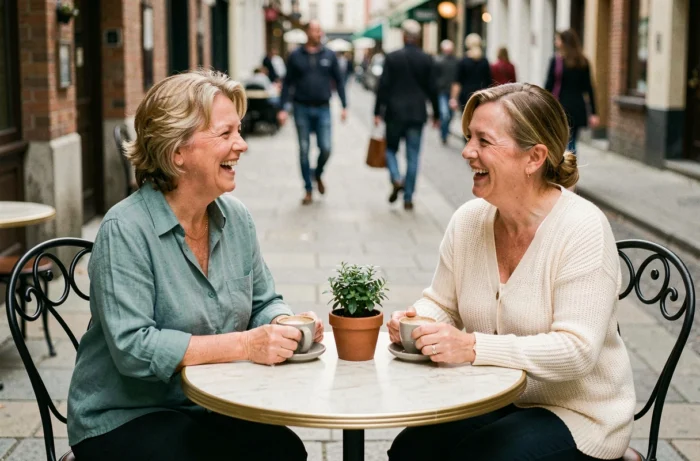
After 50, social circles often tighten without anyone deciding it. Retirement, geographical distance from children, loss of loved ones: opportunities for regular contact decrease. The World Health Organization now distinguishes between felt loneliness and social isolation, which refers to insufficient frequency of contacts.
Felt loneliness corresponds to the gap between desired relationships and those actually had. The two are not addressed in the same way, and the following advice takes this nuance into account.
Six concrete avenues allow for rekindling connections after 50, each adapted to a different profile or constraint.
1. Join a local volunteer group
Volunteering remains one of the most effective frameworks for forming lasting friendships after 50. The reason lies in the regularity: distributing meals every Tuesday or holding an association’s office every Friday creates a rhythm of attendance that builds trust. You see the same faces, share a common goal, and the relationship develops naturally.
Social centers and town halls direct individuals to local organizations actively seeking volunteers. Since social connections have been treated as a public health issue by the WHO, some municipal services even offer a “referral” to volunteering during health prevention assessments. Asking your general practitioner or a community social action center (CCAS) may be enough to find a suitable neighborhood association.
A common pitfall: committing to a structure that is too distant or too demanding in terms of time, then dropping out after a few weeks. It’s better to start with half a day a week, with the option to expand later. Those wishing to cultivate social connections on Green Seniors will find additional resources to identify nearby associations.
2. Engage in group physical activities
Nordic walking, aquagym, gentle yoga, guided hiking: collective sports activities create a natural meeting environment. The locker room, the post-session coffee break, the return trip together—these informal moments are often where friendships truly develop.
The regularity of the sports appointment matters more than the intensity of the effort. A weekly class attended for six months builds stronger bonds than an intensive one-week workshop. Clubs affiliated with sports federations offer specific time slots for seniors, often at modest rates.
For individuals with reduced mobility, alternatives exist. Some municipalities organize gentle gym sessions in community halls, accessible without long transport. This point deserves attention: a study reported by La Provence involving over 1,800 people aged 60 and above showed that mobility barriers prevent friendships from being maintained, even when motivation is present.
3. Sign up for a creative or cultural workshop
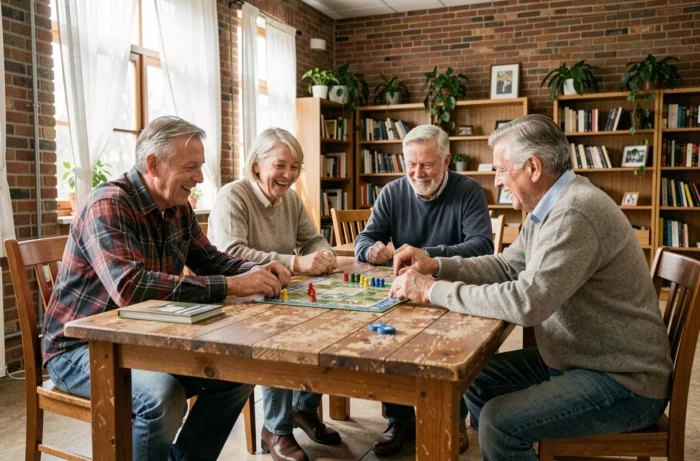
Pottery classes, writing workshops, choirs, book clubs: these activities share a common point with volunteering and collective sports, the repetition of meetings in a structured setting. The difference lies in the nature of the bond. A creative workshop exposes each person through what they produce, which accelerates mutual understanding.
Libraries and community centers remain the primary places to look. Registration fees are generally low, and the commitment is flexible. A book club, for example, only requires monthly attendance.
The mistake would be to choose an activity solely to meet people, without a genuine interest in the subject. Shared enthusiasm for a common passion remains the strongest glue for a budding friendship. If pottery doesn’t interest you, there’s no need to sign up hoping to find friends.
4. Use digital tools to extend meetings
Digital tools do not replace direct contact, but they play a role in maintaining connections between physical meetings. A message after a class, sharing a hiking photo, a video call when the weather prevents going out: these micro-interactions keep the bond alive.
A few simple tools are sufficient:
- Messaging groups (WhatsApp, Signal) allow for coordinating outings and keeping in touch daily without effort
- Video calls compensate for geographical distance, particularly useful for individuals with limited mobility
- Local associative platforms (some town halls have online directories) help identify nearby activities
Field feedback varies on the effectiveness of apps dedicated to friendly meetings among seniors. Some work well in large urban areas, much less so in rural areas. Digital tools remain a complement, not a substitute for face-to-face interaction.
5. Dare to have spontaneous conversations in everyday places
The Saturday market, the doctor’s waiting room, the park bench: these everyday places offer underestimated opportunities for contact. Starting a conversation with a neighbor or a regular at the same café doesn’t require special social skills, just simple availability.
The difficulty lies in the fear of judgment, a concern that amplifies with avoidance: the less one dares, the larger the barrier grows.
A gradual approach works better than a spectacular effort. Regularly greeting the same people, asking a question about a book seen under someone’s arm, commenting on the weather without any particular expectation. These small repeated gestures build familiarity that can lead to a real relationship.
6. Seek guidance from a health professional or social service
This avenue remains largely unknown. Since the WHO has treated loneliness as a public health issue, health professionals are more aware of identifying isolation. A general practitioner, a home care nurse, or a social worker from the CCAS can direct individuals to:
- Support groups or activities suited to mobility levels
- “Befriending” programs (regular visits by a trained volunteer)
- Solidarity transport services to access activities
Aging at home increases the risk of social disconnection, especially when mobility becomes difficult. Seeking professional support is not an admission of weakness; it is a preventive measure.
Each of these six avenues addresses a different situation. The common thread remains regularity: friendships after 50 are built through repeated contacts in a shared framework, not through one-off efforts. Choosing a single avenue and sticking to it for a few months generally yields more results than scattering attempts.