
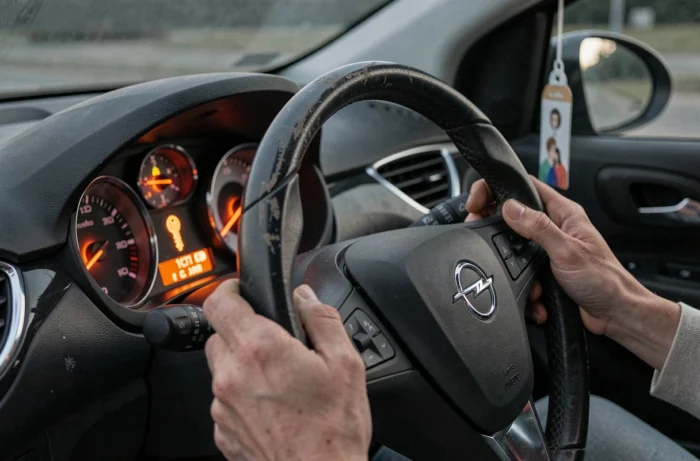
We drive along calmly, and an orange pictogram in the shape of a car accompanied by a key appears on the dashboard of the Opel Corsa. The common reflex is to think of an oil change or overdue maintenance. On this generation of vehicle, the orange key light covers very different situations, from simple periodic maintenance to an engine electronic fault with a switch to limp mode. Before taking action, we need to distinguish what the light is really signaling.
Orange key light on Opel Corsa and particulate filter: the link that forums overlook
On diesel Corsas equipped with a DPF, the “car with key” light can illuminate unrelated to regular maintenance. The pollution control system sometimes triggers this warning when the regenerations of the particulate filter are repeatedly interrupted, especially in urban use with short trips.
The signs pointing to a DPF problem rather than overdue oil change are quite clear: gradual loss of power, black smoke on acceleration, significant increase in fuel consumption. If one or more of these symptoms are observed, checking the differential pressure before and after the particulate filter provides much more reliable information than simply clearing the light with a diagnostic tool.
Clearing the fault code without addressing the cause amounts to masking the problem. The DPF continues to clog, and ultimately, a costly replacement is at risk where a cleaning or a prolonged journey on a highway would have sufficed.
Reading OBD fault codes on Opel Corsa: what a code doesn’t say
The first useful reaction when the orange key light stays on with the engine running is to connect an OBD diagnostic tool. You will obtain one or more fault codes pointing to a sensor, circuit, or system. But a fault code does not necessarily indicate the part to be replaced.
A concrete example: a code related to the lambda sensor may stem from an exhaust leak upstream of the sensor, not from the sensor itself. Replacing the sensor without checking the rest amounts to changing a part for no reason. To know if you are facing a similar case, a detailed article on the orange key light on Opel Corsa describes the most common breakdowns by generation.
Reading the code must always be followed by a physical inspection: condition of hoses, connectors, air intake, exhaust line. Without this verification, you risk replacing components at random, which often happens on forums where a member advises changing the EGR valve “just in case.”
EGR valve and diesel Corsa: why it comes up so often
The EGR valve is frequently mentioned because it clogs easily on diesel engines with low annual mileage. A clogged EGR valve can trigger the orange key light and cause irregular idling or loss of power.
Cleaning the valve rather than replacing it outright is often the most reasonable approach. Feedback on this point varies depending on the level of clogging: chemical cleaning is sufficient in some cases, while a stuck or cracked valve requires replacement.
Limp mode on Opel Corsa: to drive or to stop
When the orange key light is accompanied by a clear limitation of power and RPM, the engine control unit has activated limp mode to protect the powertrain. You can generally reach a workshop at a moderate speed, but you shouldn’t drive hundreds of kilometers in this state.
Limp mode is triggered when the control unit receives an inconsistent value from a sensor or detects an anomaly in the turbocharging, EGR, or pollution control circuit. It does not constitute a diagnosis: it indicates that something exceeds tolerance thresholds, without specifying exactly what.
Behaviors to observe to communicate the right information to the mechanic:
- Does the light come on when cold, hot, or in both cases? A light that only comes on when cold points to a temperature sensor or an intake circuit
- Is power actually limited (RPM capped, soft acceleration) or does the light stay on without any noticeable symptoms? The absence of symptoms may indicate an intermittent fault that has already been resolved but whose code remains stored
- Does the light blink when the ignition is on without the engine starting? This behavior, on certain generations, points more towards an electronic immobilizer issue than an engine fault

Orange key light after oil change on Opel Corsa: manual reset
If the light came on because the maintenance counter reached its threshold, it does not turn off automatically after the oil change. You must reset the maintenance interval via the onboard computer or with a diagnostic tool.
On the Corsa D, the manual procedure usually involves a combination of pressing the brake and accelerator pedals with the ignition on (engine off). The exact manipulation depends on the year and engine type. If this reset does not make the light disappear, you are not facing a simple maintenance reminder: an active fault code is likely stored.
When the light returns after reset
A light that comes back on a few kilometers after being cleared indicates an active unresolved fault, not a bug in the control unit. In this case, re-reading the fault codes is the only way forward. There’s no need to reset repeatedly: the mechanical or electronic problem persists.
The dashboard of the Opel Corsa communicates information that the pictogram alone is not sufficient to interpret. Noting the circumstances of the light’s appearance (when cold, uphill, after a fill-up, in the city) remains the most useful action before heading to the workshop. These details allow the mechanic to target the diagnosis instead of proceeding by elimination, which saves time and limits the bill.