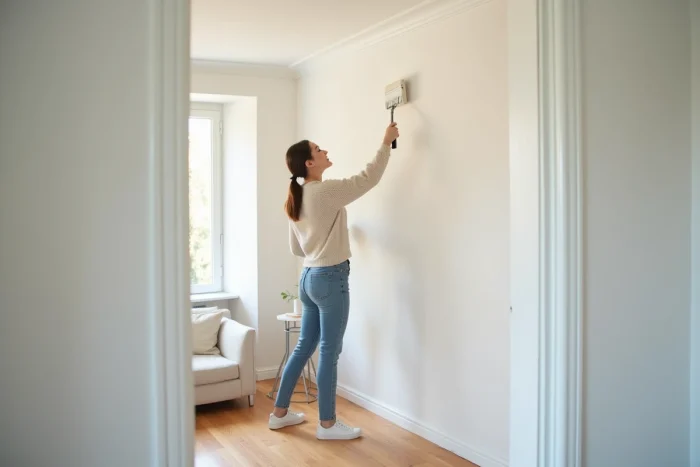
A white paint applied to walls often reveals the slightest imperfections, making surface preparation essential. Some white paints, known as one-coat, do not always provide the expected coverage, even on light backgrounds. Skipping a suitable primer can lead to the appearance of stains or unwanted shades. The choice of roller directly influences the texture and uniformity of the result. Variations in temperature and humidity affect drying time and final durability. Applying a second coat, even if deemed optional, is often necessary to achieve a uniform white.
Why white paint transforms the atmosphere of your room
White paint is not as neutral as one might think. As soon as it covers a wall, it asserts itself and redefines the room. A pure white acts as a light enhancer, energizing the volumes and giving a very contemporary feel, but it does not hide anything: the slightest irregularity stands out. In a dimly lit space, opt for a warm white; it envelops and softens the place, provides visual comfort, and avoids a laboratory effect. Conversely, a cool white enhances a sunlit area, highlights the contemporary style, showcases simple furniture, and accentuates architectural contrasts. And light does not leave white unchanged: it subtly modulates the shade according to its orientation, intensity, the time of day, or the color of the floor. To nuance the atmosphere, off-whites and tinted whites are clever allies that adapt to the existing style in the room. Structuring the space through color combinations works particularly well in a child’s room. As for moldings, they gain relief with a satin or glossy finish. To delve into the choice of shade and obtain very precise advice, find a detailed guide on the La Gazette de Constantine website.
What criteria to consider for choosing your white paint and tools
Choosing a white paint requires serious consideration of its type and finish. Overall, two categories dominate: acrylic and glycero. Acrylic, water-based, dries quickly, produces little odor, and maintains healthier air in the room. Glycero stands out for its durability and high coverage capacity, but it complicates cleaning and its application requires ventilation and caution. The finish also guides the choice: matte reduces small defects but neglects washability; satin reflects light, cleans easily, and resists dirt, a real plus for the rooms of the youngest. Velvet finds its place in an adult bedroom for its subtle touch and durability. As for details like frames or moldings, they perform admirably with a glossy or satin finish that emphasizes the architecture. Before tackling all the walls, always test the shade on a scrap or a discreet area: perception varies according to furniture or ambient light. Also, make sure to choose a low VOC paint; there are now options that are pollutant-free or antibacterial suitable for your sleeping space. To ensure every action counts, here is the equipment to prepare even before starting the work:
- Medium nap roller for even application on walls
- Cut-in brush for corners, edges, and close finishes
- Protective tarp to cover your floor and furniture
- Masking tape to neatly delineate areas to be spared
- Sandpaper to smooth out small roughness
Having the right tools and preparing each step rigorously is the secret to achieving a clean finish that withstands the test of time.
Key steps and practical tips for successfully applying paint to your walls
Preparing the ground: the foundation of any successful project
White never lies: only ultra-careful preparation offers a consistent result. Wash, vacuum the dust, then hunt down every nick, crack, or forgotten nail. Fill with compound, sand gently, then apply the primer on new, porous, or damaged walls; this lays the foundation for perfect adhesion. Carefully protect what should not end up painted: cover the floor, mask every corner, baseboard, or frame using the appropriate tape.
Application: method and consistency
Start with the corners and difficult areas using the cut-in brush for a clean outline. Then, load your roller to paint areas of about 1 m², drawing an “M” or “W”: this crossed motion ensures even distribution, without excess or shortage. Treat the room section by section, moving smoothly to avoid visible touch-ups. Patience is your ally: let each coat dry as long as the manufacturer recommends, then apply the next one. Often, at least two coats are necessary to completely mask primers, residual stains, or ghosts of the past.
To maintain control of the project at every stage, always keep these reflexes in mind:
- Start by painting the ceiling so that splashes do not affect the freshly painted walls
- Use a suitable roller: medium nap for very smooth walls, long for apparent irregularities
- Check under various lighting to spot any missed areas or excess material
As soon as the application is nearing its end, clean each tool immediately with clear water if you used acrylic paint. The more measured and consistent the action, the more light is absorbed, reflected, and gives the room that sought-after clarity. When morning comes, the entire space will be illuminated with a bright white, revealing the attention paid to every detail and that immediate sense of comfort that changes everything.