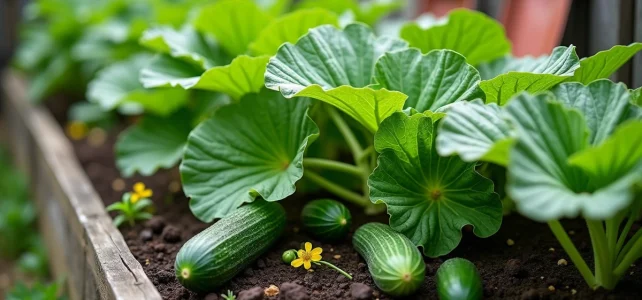
In the vegetable garden, cucumbers and lettuce occupy different layers: one climbs, the other carpets the ground. This physical complementarity triggers several mechanisms that improve productivity per square meter, reduce water stress, and limit certain pest pressures. Understanding these mechanisms allows for planning cultivation beds where each plant benefits from its neighbor instead of competing with it.
Complementary root systems: the key to better soil utilization
The cucumber develops a root network that goes deep enough to draw water and nutrients from layers that lettuce cannot reach. Lettuce, on the other hand, has a shallow root system that concentrates in the top few centimeters of soil.
This difference in rooting depth means that the two crops do not compete for the same resources. On the same bed, root competition remains low, whereas it would be high between two rows of cucumbers or two rows of lettuce.
When deciding to combine cucumbers and lettuce in the vegetable garden, we thus exploit the entire soil profile instead of mobilizing just one layer. The result is a better overall yield without increasing the cultivated area.

Cucumber trellised and lettuce as ground cover: a microclimate that limits water stress
Market gardening trials conducted between 2022 and 2024 by the ITAB experimental station and GRAB Avignon have highlighted a concrete effect: lettuce planted as living ground cover at the base of trellised cucumbers significantly reduces water stress in cucumbers during heat peaks.
The low foliage of the lettuce maintains a cooler microclimate at soil level. Evaporation decreases, and the soil stays moist longer between waterings. Cucumbers experience fewer growth spurts, which limits the production of bitter fruits.
Why trellising changes the game
A cucumber grown flat occupies the ground and prevents any intercropping. Trellised on a lattice or net, it frees up the ground surface for lettuce. The space gain is real: the same bed produces two harvests instead of one.
Trellising also promotes air circulation around the cucumber leaves, reducing the risk of fungal diseases. The lettuce below benefits from the partial shade created by the climbing foliage, a direct advantage in summer when heat causes lettuce to bolt too quickly.
Reduced pest pressure thanks to the cucumber-lettuce association
Pilot farms in Île-de-France and Loire regions monitored by the Living Soil Market Gardening network (MSV) have reported since 2023 a notable decrease in aphid attacks on lettuce when intercropped with rows of cucumbers rather than grown in monoculture beds.
The mechanism relies on two combined effects:
- Cucumbers serve as trap plants that divert some of the pests, reducing the direct pressure on the lettuce.
- The mixed cover crop provides a more favorable habitat for beneficials (ladybugs, hoverflies), which find refuge in the diversity of foliage.
- The disruption of monoculture in the bed disturbs the colonization cycles of aphids, which are used to spotting homogeneous blocks of the same species.
This observation was summarized during a technical day of the MSV network in February 2023 and later included in a bulletin from FNAB and the Bio Centre-Val de Loire Network the same year.
Successive sowings of quick lettuce for continuous harvest
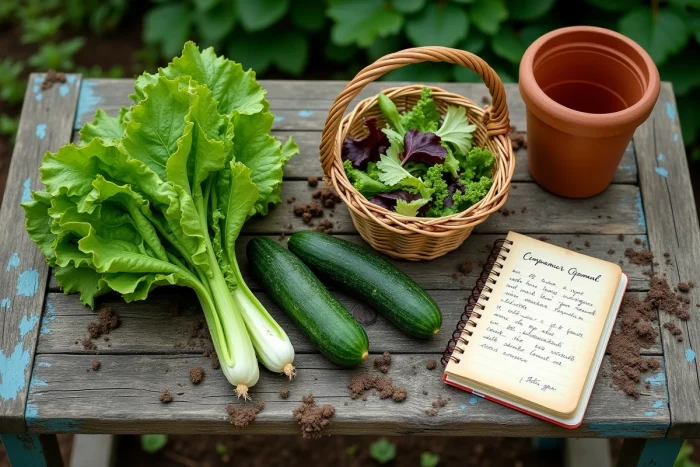
One of the most profitable aspects of this association concerns the planting rhythm of the lettuce. Recent comparisons in micro-farms show that successive sowings of short-cycle lettuce (young leaves or so-called “quick” varieties) maintain a permanent soil cover between cucumber plants.
Lettuce is harvested well before cucumbers need all the available space. The first sowing accompanies the planting of cucumbers in spring. A second follows right after the first lettuce harvest. As long as the cucumbers do not fully cover the trellis, there is enough light at the soil level to start a new series.
Which lettuce varieties to prioritize
Cutting lettuces and mesclun work better than head lettuces in this configuration. Their short cycle (a few weeks between sowing and harvest) allows for several passes before autumn. Lamb’s lettuce takes over at the end of the season when cucumbers decline and light at the soil level becomes abundant again.
- Cutting lettuce type “oak leaf”: fast cycle, tolerates partial shade, harvested leaf by leaf without uprooting the plant.
- Mesclun: a mix of young shoots that quickly covers the soil and is harvested continuously.
- Lamb’s lettuce: ideal for the rotation at the end of cucumber cultivation, it appreciates the cooler temperatures of late season.
This calendar of successive sowings transforms the cucumber-lettuce bed into a productive system over several months, with soil that is never bare. The space gain and continuity of harvests alone justify the initial planning effort.
The logic behind this association is based on simple principles: exploit different layers, permanently cover the soil to limit evaporation, and diversify crops to disrupt pests. Field feedback confirms that these benefits are not theoretical. One practical detail often overlooked remains: space cucumber plants slightly more than usual to allow lettuce the light they need in the first weeks.