
Drawing for years, filling sketchbooks, going through online tutorials, and ultimately wondering if a structured training could turn this practice into a profession: this journey concerns an increasing number of profiles, not just high school graduates. The question is not whether drawing is a calling, but what entering a specialized school concretely changes in the trajectory of a self-taught illustrator.
Artist-author status and Urssaf: what awaits illustrators after school
Even before discussing pedagogy, an administrative point conditions the viability of the project. Since the reform of 2022, the management of social contributions for artist-authors (including illustrators) no longer goes through the Maison des Artistes. It is now the Urssaf artists-authors (Urssaf Limousin) that centralizes income declarations, quarterly provisional contributions, and the mandatory annual declaration.
For a young graduate who lands their first freelance commissions, this shift requires mastering a declaration circuit that is anything but intuitive. Schools that include a module on the professional status of the illustrator better prepare their students for this reality. Those that do not discuss it leave their graduates to discover a system where a declaration error can lead to heavy adjustments as early as the second year of activity.
The decision to enter a school of illustrator drawing should therefore take this criterion into account: does the program address the social and fiscal framework of the profession, or does it limit itself to graphic techniques?
Training in drawing-illustration: what a self-taught person does not work on alone
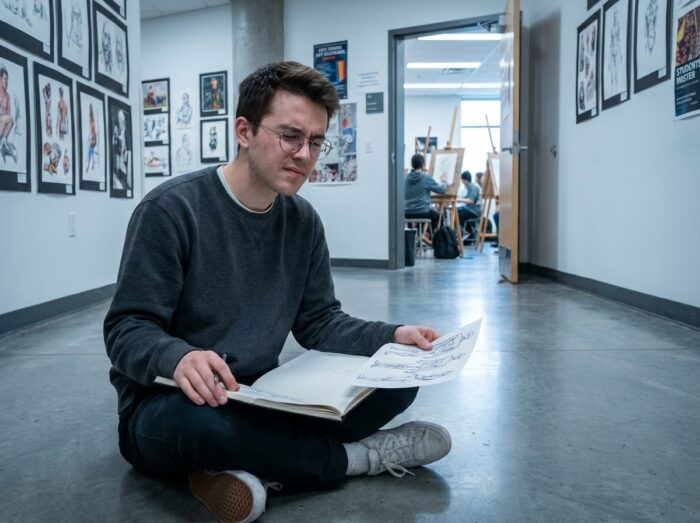
A passionate illustrator often develops a personal style, sometimes very refined aesthetically. What is generally lacking is not the drawing skill, but the method of professional production. Specialized schools structure learning around skills that free practice rarely addresses:
- Applied visual storytelling (storyboarding, sequencing, text-image relationship), which differs radically from observational drawing or fan art
- Adhering to a client’s specifications with constraints on format, deadlines, and imposed artistic direction
- Mastery of standard digital tools in the industry (Photoshop, Procreate, Clip Studio Paint) within a production workflow, not in free exploration
- Training in life drawing for extended periods, a structuring exercise that few self-taught individuals practice regularly
Knowing how to draw and knowing how to produce a commissioned illustration are two distinct skills. Training does not replace talent, but it bridges the gap between personal practice and the demands of a client.
Field feedback varies on one point: the necessary duration. Some short programs (one year) are sufficient for profiles that are already very advanced technically. Other courses of three to five years target students who start from a more generalist level, often after a high school diploma in applied arts or a preparatory course.
Supplementary income and early career: the real financial constraints
Decree No. 2020-1095 of August 28, 2020, established a cap on supplementary income for artist-authors (workshops, classes, conferences). This cap, reassessed each year, directly affects illustrators at the beginning of their careers who supplement their commission income with teaching or occasional interventions.
This constraint is rarely mentioned in school brochures. However, it has a concrete impact: a freshly graduated illustrator who teaches drawing in the evenings to make ends meet must monitor the threshold beyond which this income falls outside the artist-author regime. Exceeding this cap can lead to a partial reclassification of the activity, with consequences for contributions and social coverage.

Anticipating the economic model of the first years is part of the training project. Schools that organize meetings with illustrators active for three to five years offer a more realistic vision than those that only highlight exceptional paths.
Choosing your school of illustrator-drawer: the criteria that differentiate programs
The landscape of illustration training in France mixes public schools (Fine Arts, decorative arts), recognized private schools, and less regulated organizations. The cost difference between these options is significant, but the price does not automatically correlate with the quality of professional integration.
Three elements deserve direct verification before applying:
- The recognition of the diploma: a title registered with the RNCP (National Directory of Professional Certifications) attests to a level validated by the State, which carries weight with certain employers and for access to continuing education funding
- The professional integration rate at six months and two years, which some schools publish through internal observatories or platforms like InserJeunes for the professional pathway
- The proportion of projects completed with real clients (publishers, studios, agencies) during the course, as opposed to purely academic exercises
A diploma without an integrated professional network significantly slows access to the first commissions. Schools that operate with an active address book in publishing, animation, or video games facilitate the transition to the job market.
The available data do not allow for an absolute ranking of schools: integration rates vary according to cohorts, chosen specializations, and the state of the sector. A motivated candidate has every interest in directly contacting former students rather than relying solely on the figures displayed on institutional websites.
The passion for drawing remains the driving force, but it is not enough to guide the choice of a school. The administrative framework of the illustrator’s status, the economic model of the first years, and the ability of a program to connect its students to the professional market are the three parameters that transform a desire into a viable project.